

 Subscribe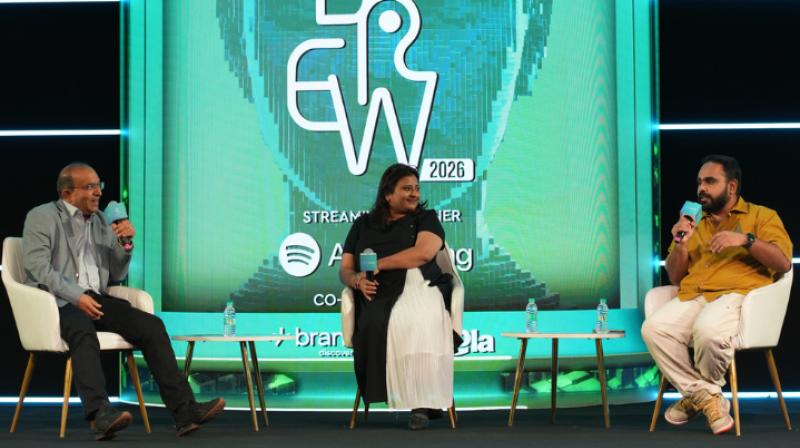
 L to R: MA Parthasarathy, Eashwari Deshpande and Siddhaarth Aalambayan.
At Brew 2026, hosted by WPP Media India on 12 May, a panel discussion spotlighted the evolving relationship between creators, audiences, and brands.
Set against the summit’s theme, ‘Brewing Disruption: Where Disruption Fuels Creativity’, the session explored how long-form content is deepening audience relationships, why creators are emerging as trusted recommendation engines, and how brands need to rethink campaigns as sustained partnerships rather than short-term spikes.
Titled ‘All Aboard the Pod Train!’, the panel featured Siddhaarth Aalambayan, creator and host of The Bombay Journey podcast, Mashable India, and Eashwari Deshpande, head - Google and YouTube brand and reputation and YouTube ads marketing.
The two unpacked why podcasting is emerging as one of the most immersive and credible spaces for marketers today.
The session was moderated by MA Parthasarathy, ex-strategy leader, WPP Media.
Opening the session with an anecdote about being recognised at a Durga Puja pandal, Aalambayan reflected on how podcast creators are increasingly becoming part of mainstream culture.
“Have you ever been to a pandal and seen people call out celebrities in the spotted one? I was at a Durga Pooja pandal two years ago, and this man just waved at me, and he said, ‘Hey, YouTuber, idaar aa’. So I don't know what part of the cultural side am I on. Am I creating pop culture, or am I pop culture?” he said.
Drawing parallels with legacy television brands, he added that creators and podcasters today are becoming the new-age entertainment networks.
He voiced, “Think of the traditional channels back in the day, like MTV, Discovery and NatGeo. Today, Mashable India, Hauterrfly and all of us are these people.”
According to Aalambayan, the power of podcasting lies in the long-term nature of audience engagement. Recalling another interaction with the same fan a year later, he said, “This time, he knew I was Siddharth, he knew my wife's name, he knew where the next content piece was going to be dropping, and he knew what I had done on the third last controversial one," he added.
Deshpande pointed out that podcast creators command a level of trust that extends beyond traditional influencer marketing because of the depth of audience relationships built through long-form content.
“What podcasters have, which is a little bit above multiple other influencers and celebrities, is that the connection they have with their communities is very strong because people are engaging in long-form content,” she said.
She noted that audiences today move fluidly between short-form snippets and long-form episodes, creating stronger familiarity and authenticity around creator recommendations.
“People know that when they're talking about a brand, it is from an authentic place. It is credible. It's not just out there because they're getting paid for it," Deshpande shared.
Deshpande also highlighted how podcasts are shifting from passive consumption to more intentional viewing behaviour. “One would think that podcasting is a lean-back format, but it is actually becoming more of a lean-forward video experience, even appointment-based, because creators drop episodes at a particular point in time.”
Moving beyond campaign spikes
Aalambayan stressed that brands need to stop viewing podcast integrations as one-off campaign bursts and instead approach them as long-term associations.
“The Bombay Journey was presented by Castrol. I still remember the line - ‘80% more synthetic engine oil’. We’ve had Hyundai buy in for 30 episodes through the year,” he said.
He explained that audiences often retain not just the brand association but also contextual storytelling around the product. Aalambayan voiced, “They remember Castrol, they remember the mechanic coming in and putting in oil, and they remember that I drive a Hyundai car.”
The creator also pointed to the growing sophistication of podcast analytics and viewer behaviour on YouTube.
“India is consuming podcasts heavily, with 51% actually watching it on the TV screen,” he said, adding that YouTube’s dedicated podcast tab is helping creators make more informed content and brand decisions.
Community-led influence and commerce
The discussion also touched on how podcast communities are influencing purchase decisions in increasingly direct ways.
“We do meetups, merch, community engagement programmes where we realise the same names are showing up repeatedly,” Aalambayan said. “They know my family values, they know me on Instagram, they know me across socials.”
He added that relatability often drives audience trust in creator-led recommendations. “If I'm talking to a mechanic and talking about usage, audiences think, ‘He looks like me, sounds like me, eats at the same places as me. I also want to use the same oil for my car as he does.’”
Aalambayan revealed that audiences frequently ask creators for buying advice, including automobile recommendations. “People have started asking me what car to purchase. So many celebrities have started getting influenced.”
Looking ahead, he said, emerging commerce integrations such as YouTube Shopping could further collapse the gap between content and conversion. “I’m interested in seeing if I can wear something from Men of Platinum, put a shopping link, and actually see a purchase decision being made through my podcast.”
Deshpande argued that the rise of podcasts reflects a much broader shift in consumer behaviour.
“No one’s going through a linear funnel anymore,” she said. “We’re streaming, shopping, scrolling and searching all at once.”
According to her, podcast formats now allow brands to participate across multiple discovery and decision-making moments simultaneously. “One's brand could be discovered through a short clip from The Bombay Journey, audiences could then go deeper into the long-form episode, and eventually make a purchase because the comments and community engagement make the recommendation feel authentic.”
She added that creator trust continues to remain one of the strongest drivers for marketers. “About 50% of people have told us that they trust recommendations from creators even when they know that they're paid.”
Unlike traditional celebrity endorsements, she explained, creators feel inherently relatable to audiences. Deshpande spotlighted, “Creators are people who are like me. They talk my language. They've had a similar journey to the one I have had. Therefore, my inherent trust in them is immediate and lasting.”
How can marketers juice podcasting
As the session moved towards the future of creator-brand collaborations, Aalambayan made a case for stronger creative partnerships and better briefs from brands and agencies.
“You all gave us such great briefs, and now the briefs are getting brief,” he joked.
He acknowledged that marketing today is becoming increasingly difficult, particularly with younger audiences becoming more conscious and selective. “Gen Z is very picky. They are aware of where you are cutting trees. They are not drinking. They are a very aware generation.”
According to him, podcast integrations work best when they are immersive and native to the creator’s style rather than overt sponsorships.
“Don’t make me repeat the tagline seven times in a podcast,” he said.
Summing up the unpredictability of digital culture, Aalambayan added, “We all want viral videos. If I knew what would go viral, I wouldn’t be sitting here. Nobody knows what goes viral.”
Deshpande summed up podcasting’s appeal for marketers in three parts: “One, the credibility of the podcaster. Two, the fact that it allows you to travel many rooms, many screens and many formats. And three, the fact that you will get deep community engagement through a creator.”
Adding to that, Aalambayan urged brands to engage with the entire creator ecosystem rather than just the final piece of content. “Indulge in the whole lifecycle, from the story on Instagram to dropping a comment, to talking to their audiences, to the community post on YouTube, to finding the long-form content, to having a giveaway, to doing UGC for that giveaway," he summarised.