

 Subscribe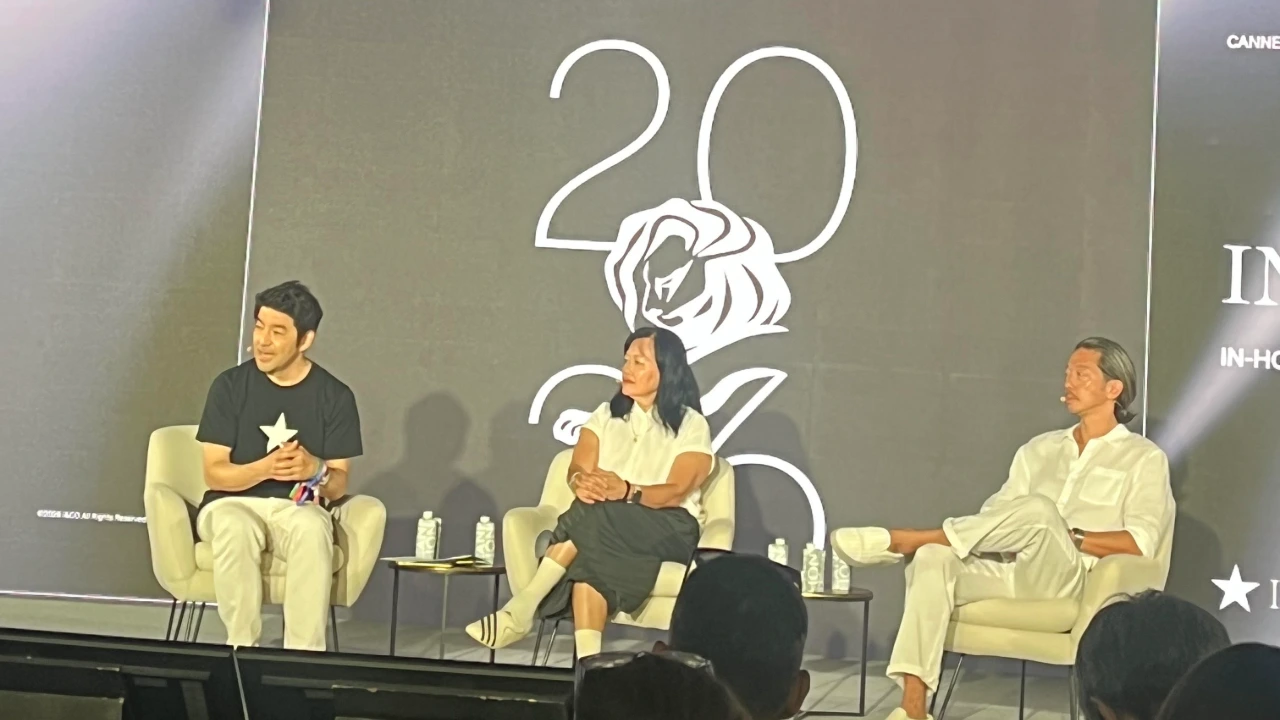
 From left: Rei Inamoto, Judy John and David Lee
During day three of the Cannes Lions International Festival of Creativity, the Rotonde Stage hosted a debate around one of marketing's most enduring questions: should brands build in-house capabilities or rely on agency partners?
The speakers of the 'Inside Out: In-house or agency?' included David Lee, chief brand and creative officer, SquareSpace; and Judy John, global CCO, Edelman. The debate was moderated by Rei Inamoto, founding partner, I&CO.
During the session, both the speakers were given three provocations to discuss on and each shared their own perspective on the argument.
Provocation: In-housing everything is a bad move for most brands and a perpetual career risk for CMOs
John: I agree. They know the brand, the politics, the product and the pressure. They're the closest to the machine. But I also think that that's the problem. The closer you are towards the machine, the harder it is to see what the machine is going to do to and have a break out of it. The agencies bring relevance and objectivity. We can say to the client that customers don't care about something. It might be beautiful for internal purposes, but no one will ever care it or notice it. That is incredibly valuable. It’s necessary and annoying, but it's also why it works and why the tension is important. It’s the same thing as barbers having the worst haircuts.
Agencies bring cross category intelligence and cultural input. In-house is great at going deep into the business, but agencies go wide across the world. Creativity happens when one world infects another. It infects the vision of input and ideas.
The third thing is that agencies keep that creative muscle under constant tension. Solving different problem across different businesses either makes you better or crash. That’s the range that really matters.
Lee: I agree to the most part of it but not entirely. The reason why I agree is that I think it's really contextual to the brand and what your DNA of that brand is. But most brands start an in-house agency for the wrong reasons. If you're a CMO and you build an in-house agency, and let's say it's mediocre at the best, you will have no one but yourself to look at it in the mirror, when you're accountable for the bills. Most brands do it because they think it's cheaper. I can tell you, it's not, the human capital is expensive.
I think it doesn't make sense for most brands to do it unless you really have the courage to actually do that because you have no one but yourself to point at. This might be a little bit provocative statement to say but I think when the business goes south and the work isn't great, you can always point the finger somewhere else.
Provocation: Outsourcing creative is essentially a challenge for brands that can’t find their own voice
Lee: I do agree with this one in the sense that whether you work with an in-house agency or work with great external agencies, it has to come with a social truth. A company doesn't know who they are, who their customers are, what they stand for, or what their value proposition is. I don't know if outsourcing that to an external agency is gonna necessarily help. I think there needs to be a little soul searching before you engage with freelancers, external agencies, consultancy and firms. The way I've always looked at it is that the source of truth, the real DNA has to come from inside. It doesn't mean you can't have help to ideate any shared visions with partners. But I feel like there's something so innate, uh, in this statement over here, and that if you don't know who you are as a brand, and you don't have that foundation in place, I think you have problems.
John: I agree. I think it's important for clients to know who they are. And I think that what an outside agency can help you with is the focus. Strategy is about simplifying and making decisions. Agencies can just say that these things are not important and this is important to. Creativity is all of our responsibility and it needs a system.
Provocation: In the age of augmentation, creativity really doesn’t matter
John: Creativity is what separates the AI swamp. You have to earn your way into the conversation. There is so much content in the world right now and we're just gonna create more. Everyone is going on with AI that it's so exciting, and we can create so much content. But we are just putting more digital garbage in the world. Creativity is what separates the boring. We talk about creativity a lot at this festival but not much after we leave from here. We talk about optimisation, efficiency, algorithms, and feeds but not creativity. Creativity creates magic that stops you, that creates the emotion. Picking different inputs and smashing them together, that’s magic.
Lee: Creativity is an original thought. It is about finding a simple solution to a complex problem, or it's about finding a unique original idea for a simple learning problem. In creativity, you're triangulating things that shouldn't be put together in an interesting way and then tying a little thread around it.
I don’t agree with this argument though. In this world that we're in today, where anyone could create anything from content, I would argue creativity in your brand and the building that you need to do is more imperative than ever. That is because the signal to noise ratio is going to be wild in the future. There's going to be so many business ideas and pieces of content that it will become very difficult to buy that signal to noise ratio in the future.