


 Subscribe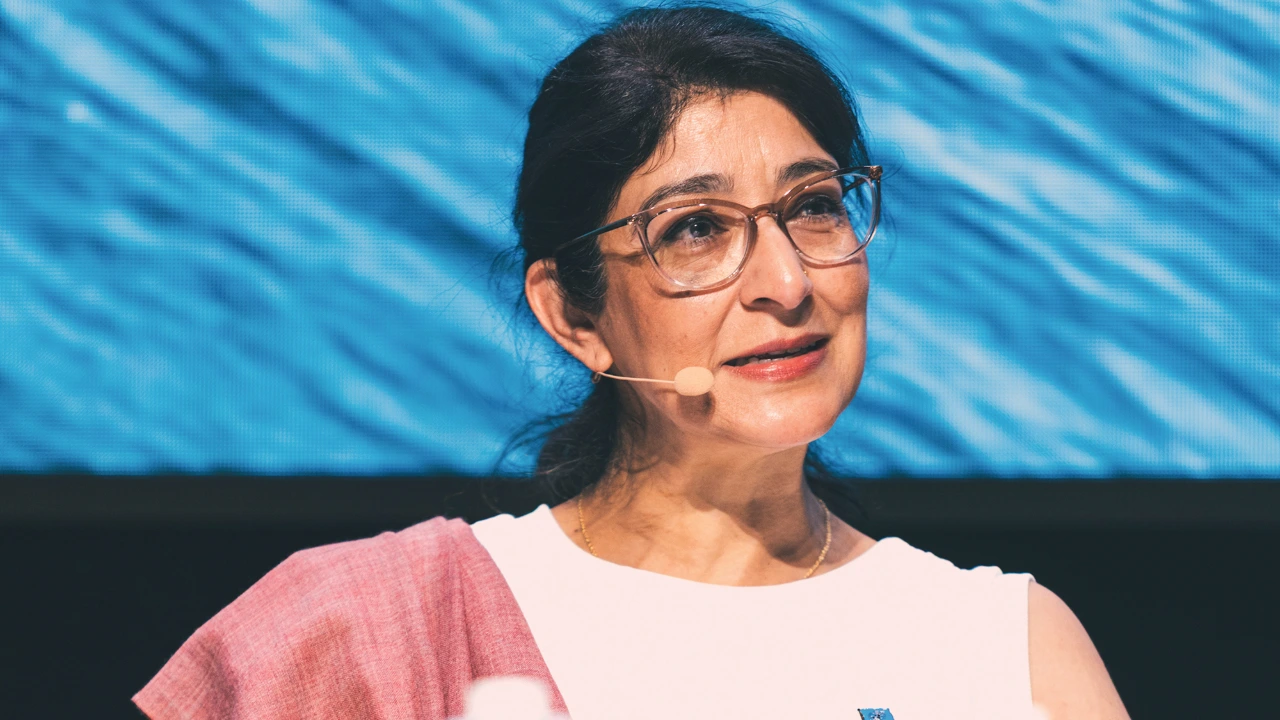
 Aarti Holla-Maini
Most conversations at the Cannes Lions International Festival of Creativity revolve around brands, creativity and culture. But one session shifted the conversation far beyond Earth.
At the festival, the United Nations Office for Outer Space Affairs (UNOOSA), in collaboration with the PVBLIC Foundation, brought together physicist Brian Cox, commercial astronaut Sian Leo Proctor, and UNOOSA director Aarti Holla-Maini for a compelling discussion titled ‘Space Isn’t the Future – It’s Your Brief.’
Their core message was simple yet profound: space is no longer an abstract frontier - it is critical infrastructure underpinning modern life.
Following the session, Manifest caught up with Holla-Maini to understand why the creative industries have a crucial role to play in shaping the future of space governance, why brands should rethink their relationship with space, and how better storytelling could ultimately help safeguard the planet.
For Holla-Maini, Cannes Lions was a strategic opportunity to enlist one of the world’s most influential creative communities.
“Our purpose in being here was to really make sure that the broader community, which is involved in creativity and information and communication, also supports our efforts to bring space down to earth and spread the word about how important space is and the work of the United Nations Office for Outer Space Affairs.”
She was candid about the challenges facing the organisation.
“We are way too small; we cannot get the word out ourselves. We’re struggling for funding support, we need people, we need more support, and we see the creative industry as a vehicle that can potentially help us create that excitement and willingness to partner with us.”
It is an unusually direct appeal from a senior UN official, but one rooted in pragmatism.
Holla-Maini’s belief is that advertising, marketing and communications possess something governments often lack: the ability to inspire attention, build public understanding and influence priorities.
That becomes especially significant because, despite the rapid commercialisation of space, many brands still fail to recognise its strategic importance.
“So, I think that brands don’t realise the strategic potential of space.”
She noted that today’s businesses are increasingly expected to balance commercial performance with environmental and social responsibility.
“I think that companies, corporates, they’re there to make money and to deliver on their shareholders’ expectations, but we live in an age where if one doesn’t have a CSR or an ESG policy, you’re going to lose your investors.”
The opportunity, she believes, lies in recognising that space isn’t disconnected from sustainability - it enables it.
“Given that space responds to every single one of the United Nations Sustainable Development Goals, I believe that every company will find an angle which could be of relevance to them, and that we can help, we can use the creative leverage, the creative industry to try to reach companies on that angle to entice them to work with us.”
For brands wondering where to begin, her advice is straightforward.
“Look at the Sustainable Development Goals, and tell me, which area interests you. Is it the oceans? Is it education? Is it healthcare? Which vertical would you like to align with to make you, as a company or as a brand, look good? Tell me that, and I’ll give you the story that goes with it. It’s connected to space. It all ties back to space. There is a story behind every single sustainable development.”
That perspective reframes space not as an industry confined to rockets and satellites, but as the invisible backbone supporting everything from climate monitoring and disaster response to agriculture, healthcare and education. Yet while commercial investment in space continues to accelerate, Holla-Maini stated one critical area remains dramatically underfunded: governance.
For her, this imbalance is increasingly difficult to ignore.
“Basically, for us, it comes down to funding. We are an office of the UN, which is not prioritised by the UN system itself, and that’s because member states are not prioritising it.”
She points to the stark contrast between military investment in space capabilities and the comparatively limited attention given to ensuring space remains usable for future generations.
“If we look at within the European Union, for example, or even beyond, the amount of money which has gone into space in terms of defense and defense capabilities, whether it’s satellite communications or whether it’s space situational awareness to protect assets in space, those numbers are exploding, but when we look at the peaceful uses of outer space and the work that is done around policy and governance, that is not prioritized at all. And that has to change.”
“If you want to use space for defence, you’d better want to protect space, and that means you need to work with our office,” she added.
Contrary to perceptions that regulation slows innovation, Holla-Maini argued the opposite. The UN, she said, has already helped establish a thriving commercial environment through decades of treaties, principles and international cooperation.
“I don’t think we need to do anything more to encourage and support innovation. We’re already doing that.”
Instead, the next challenge is providing clarity.
“What investors want to see now, what companies are calling for, is more regulatory certainty as innovation creates new opportunities.”
Whether companies hope to mine resources on the moon, manufacture in orbit or develop new space services entirely, investment depends on predictable rules.
“For example, mining the moon, building things on the moon, what are the guidelines and parameters within which you can do that? How are we going to invest in that if we don’t know how far we can go and where we need to stop?”
For Holla-Maini, governance is not bureaucracy; it is an economic enabler.
“This is the reason why governance is worth investing in, because it provides regulatory certainty.”
One example illustrates her point particularly well: space debris.
With thousands of inactive satellites and fragments already orbiting Earth, debris removal has become one of the fastest-growing commercial opportunities. Yet despite the obvious demand, investment remains limited, she pointed out.
“There is so much debris out there, there’s only a handful of companies that are actually looking at removing it.”
The missing ingredient, she says, is policy.
“What is missing is the policy guidance which may obliges removal of debris, which legitimises debris removal as a legitimate global activity.”
Strong governance creates confidence.
“If one has these kinds of frameworks, policy frameworks in place, one can provide a regulatory framework, which is critical for investment,” she stated.
The complete article is available in the July issue of Manifest, which can be bought here.