

 Subscribe
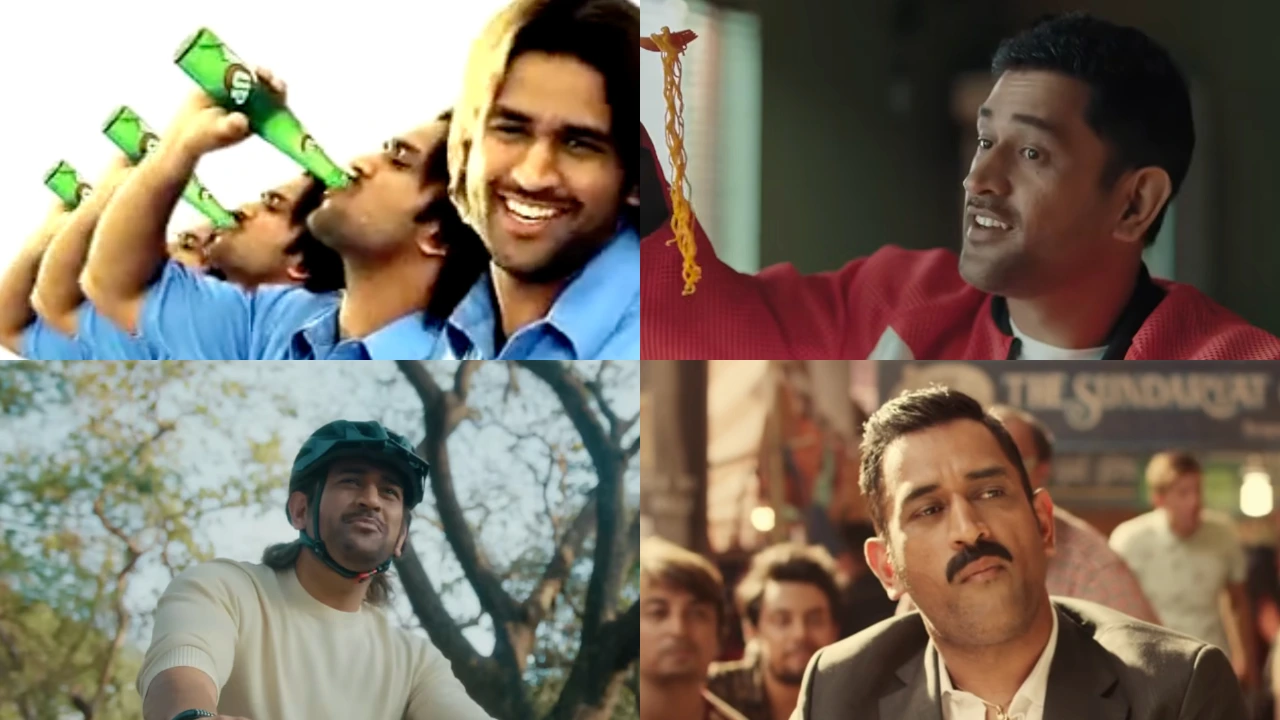
 Dhoni in his different brand avatars
From singing a viral meme for EMotorad to delivering an unforgettable line for 7UP in his early years, MS Dhoni’s advertising journey has mirrored his evolution from a small-town cricketing sensation to one of India’s most enduring brand personalities.
Riding an electric cycle through the countryside, Dhoni sang ‘Bole Jo Koyal’, accompanied by two animated birds who admired both his singing and his ride. It was an unexpected turn for a personality better known for his measured demeanour than for breaking into song. But the film for EMotorad worked. The campaign drew on a meme that had followed Dhoni since 2019, when a video of his lookalike dancing to the song began circulating online. The track became a recurring reference in the internet’s Dhoni universe, particularly during the IPL. EMotorad’s idea was to bring the joke full circle by getting Dhoni himself to sing it.
It was a clever bit of self-awareness. Rather than distance himself from the meme, Dhoni embraced it, turning an internet in-joke into a brand moment. The film, created by One Hand Clap, also demonstrated that the cricketer’s appeal could extend beyond the familiar tropes of leadership, winning and composure. He could be funny, spontaneous and, as it turned out, a singer too.
The EMotorad film was not an isolated experiment. The brand returned with another campaign in September 2024, ‘Dil Se Aawaaz Ayegi’, in which Dhoni imitated the sounds of different motorcycles before demonstrating the joy of riding an electric cycle. In 2025, it brought him together with filmmaker Sandeep Reddy Vanga for another film. The association showed how a brand could build on a celebrity’s cultural currency rather than simply rely on his face.
But Dhoni’s advertising story began long before memes and social media made celebrities more accessible to audiences.
The early years: From ‘Anhoni’ to Dhoni
In the early years of his international career, Dhoni was still establishing himself as a cricketer and a recognisable face. His long hair, fearless batting and unconventional approach made him stand out. Advertisers were quick to recognise the potential.
One of the memorable early associations was with 7UP. The commercial is remembered for the line, ‘Anhoni ho gayi honi aur main ban gaya Dhoni’, delivered in Dhoni’s distinctive style. The line was catchy, irreverent and rooted in the excitement around a new cricketing personality. It also offered an early glimpse of the humour that would become a recurring part of Dhoni’s advertising persona.
Another early association was with Videocon, where Dhoni appeared alongside Shah Rukh Khan in a campaign built around making the most of whatever role life offered. The pairing brought together two stars from very different worlds, while placing Dhoni alongside one of the country's biggest entertainment personalities. It was also an indication of how quickly he had moved from being a cricketing discovery to a mainstream celebrity.
Captain Cool becomes a brand
As Dhoni’s career gathered momentum, so did his value to advertisers. His leadership of India to the 2007 T20 World Cup and the 2011 ICC Cricket World Cup gave brands a personality who could represent success without appearing overly flamboyant.
The ‘Captain Cool’ identity became central to his advertising appeal. Brands could use him to communicate confidence, reliability, performance and composure. At the same time, his popularity cut across age groups and geographies, making him an attractive proposition for categories well beyond cricket.
Pepsi tapped into his cricketing persona with campaigns that played on his unconventional approach to the game, including the association with the helicopter shot. Boost, too, used the familiar sporting territory of performance and aspiration. These were natural fits for a cricketer whose achievements had made him a role model for young audiences.
But Dhoni was never restricted to playing the serious sporting hero. His advertising work increasingly leaned into comedy and self-deprecation. The Snickers association, for instance, played with the idea of a person behaving differently when hungry, while GoDaddy’s ‘Bijness Bhai’ films gave him a distinctly different character to inhabit. The latter saw him play a business-minded personality speaking to India's growing community of entrepreneurs and small businesses.
That ability to move between roles was an important part of his longevity. Dhoni could be the dependable captain in one campaign and the comic centrepiece in another, without either portrayal feeling entirely out of character.
Dhoni’s endorsements also reflected the widening range of categories seeking his association. From consumer durables to healthcare, financial services, automobiles and agriculture, he became a familiar presence across Indian advertising.
Orient Electric used him across campaigns for its fans and other products. Colgate featured Dhoni alongside his wife Sakshi in a campaign around inner strength. Sunfeast YiPPee! used his playful side to communicate with younger consumers, while Lay’s brought him into a campaign that played on the emotional connection fans have with the game.
The value of staying relevant
Dhoni’s advertising journey has been unusual because his appeal has survived several phases of his public life. There was the young cricketer with the long hair and the audacious batting style. Then came the captain who led India to major international victories. He became the face of Chennai Super Kings, a franchise whose identity has been closely associated with him. And, over time, he became an internet personality whose smallest gestures, expressions and appearances could trigger a wave of memes.
Brands have been able to draw from each of these identities. His sporting achievements have given him credibility, his calm demeanour has made him dependable, and his willingness to participate in humour has kept him relatable.
That is perhaps why the EMotorad film felt so effective. It was not another advertisement asking Dhoni to talk about winning, leadership or performance. It allowed him to do something unexpected and, in the process, reminded audiences that the person behind the public image could take a joke.
For advertisers, that is a rare kind of longevity. Dhoni has not just remained recognisable. He has found ways to remain relevant.
Watch some more iconic brand campaigns featuring the former Indian captain.