

 Subscribe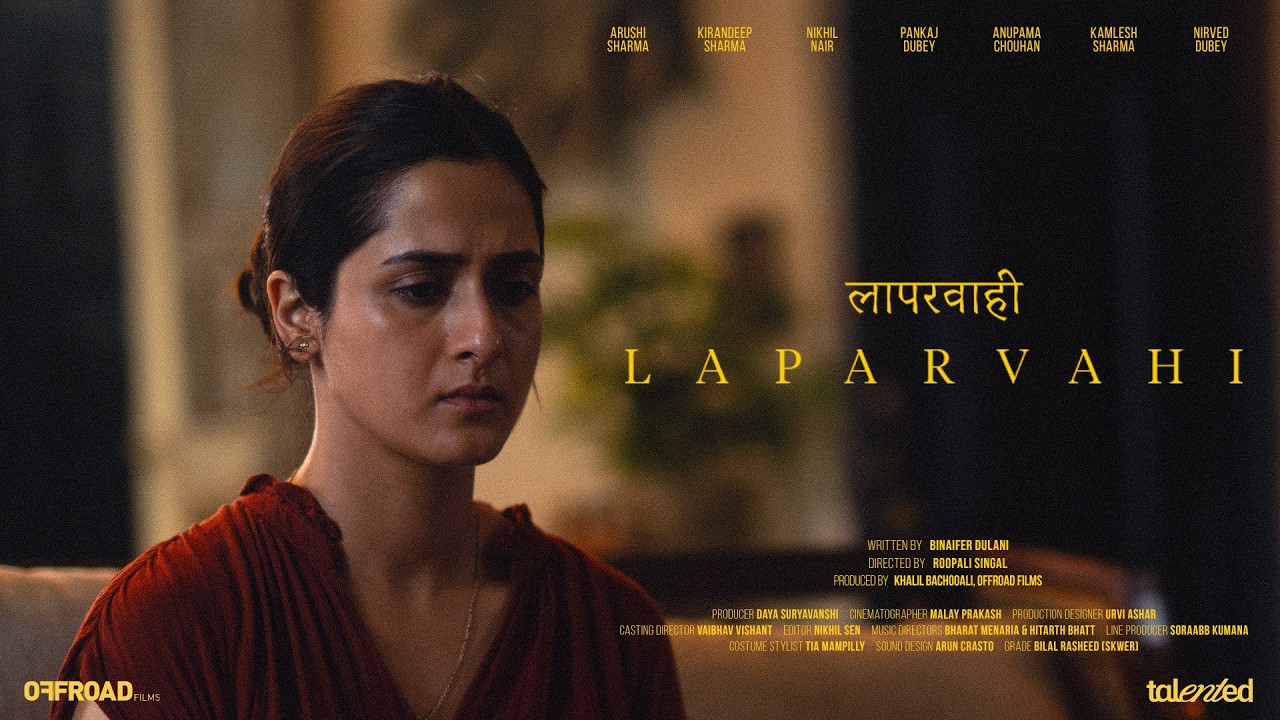
 Laparvahi was released on 26 September
Talented has rolled out a short film, Laparvahi, which looks at miscarriage not through the lens of tragedy alone, but through what happens afterwards - the silences, the self-blame and the well-intentioned attempts to make grief disappear.
Written by Binaifer Dulani, founding partner and creative, Talented, directed by Roopali Singhal and independently produced by Khalil Bachooali of Offroad Films, the film deliberately avoids creating a villain.
At the heart of the film is a question many women who experience miscarriage may ask themselves: Kahan laparvahi ho gayi mujhse?
Chatting with Manifest, Dulani, stated the question was the starting point.
“The idea for Laparvahi started with a simple insight: women who go through a miscarriage often carry guilt and self-blame," she said.
The above question, she believes, is shaped by the way miscarriage is spoken about — or more often, not spoken about — within Indian families.
“Miscarriage is rarely spoken about openly. It becomes Chinese whispers, shrouded in secrecy, and in the process, we lose the stories of the women who have gone through it before us,” she added.
“So every woman feels like she’s going through it alone, and in that loneliness, blames herself,” Dulani adds.
That is where the film’s title becomes its central idea. Laparvahi-carelessness or negligence-initially appears to point towards the woman. The film turns that assumption around.
“We wanted to take that very word, laparvahi, and flip it,” says Dulani. “Because the real laparvahi is not hers. It is ours.”
For her, the failure lies in a society that has not created enough space for these experiences to be shared openly. It lies in the absence of conversations that could tell a woman that she is not the first, that others in her own family may have experienced the same loss, and that there was never a reason for her to carry the blame.
That idea also resonated with producer Bachooali, who stated that making the film changed his own understanding of miscarriage.
“I have always known what a miscarriage is. But through the process of making this film, I realised that I had never really understood what it can mean,” he said.
"For many women, miscarriage is 'a monumental loss' that is nevertheless often experienced quietly. Guilt and shame can accompany the loss, along with the suggestion, sometimes explicit, sometimes merely implied, that the woman may have done something wrong. Her body somehow failed her, or that there is something deficient in her. None of that is true," Bachooali added.
On the film, he added, "It is in the space between intention and impact. The people around a grieving woman may not be trying to hurt her. They may be trying to help. But advice, explanations, reassurance and an instinct to move on can sometimes make it harder for someone to actually process what has happened."
That distinction was important to the filmmakers.
Bachooali says the film began when Dulani approached Singhal with a question: “What can we do to help women speak about miscarriage without guilt?”
But the more important question for him was what could be done to change the response of everyone around them.
“Because the responsibility cannot only be on the woman who has experienced the loss to explain her grief to us,” he said.
“As family, friends, partners and colleagues, perhaps we need to learn how to listen better. To be more informed. To be more sensitive. To know when not to offer an explanation or an opinion. And sometimes, simply to be present,” added Bachooali.
It is a deceptively simple thought, but one that gives the film its emotional weight. Laparvahi does not attempt to turn miscarriage into a dramatic plot device. Instead, it focuses on the quieter aftermath — the things said, the things left unsaid, and the internal conversation that can leave a woman wondering whether she was somehow responsible.
The film emerged from conversations with women who have experienced miscarriage, as well as an observation about how deeply self-blame can become embedded in the experience. A scan, for instance, can begin to feel less like a medical examination and more like a report card on one’s own body.
In that context, the film’s intervention is not simply to tell women that they are not alone. It is to ask why they should have to discover that alone in the first place.
For Dulani, changing that requires bringing more stories into the open.
If women knew the experiences of mothers, sisters, friends and colleagues who had gone through miscarriage before them, perhaps the question would begin to change. From What did I do wrong? to Why was I made to believe this was my fault?
That is the larger idea behind Laparvahi: sometimes the most damaging part of grief is not the absence of care, but the absence of language.
The film was made independently, with Bachooali saying that everyone involved understood the responsibility that came with the subject. He credits the crew for approaching the production with 'enormous sensitivity, honesty and heart, and not like any other shoot'.
Singhal said, “There is no villain. Everyone in this family is speaking from a place of love and concern. The discomfort, she believes, comes from the fact that people can be trying to help while unknowingly adding to someone’s guilt."
Manifest was media partner for the film which was released on 26 September in Mumbai.