

 Subscribe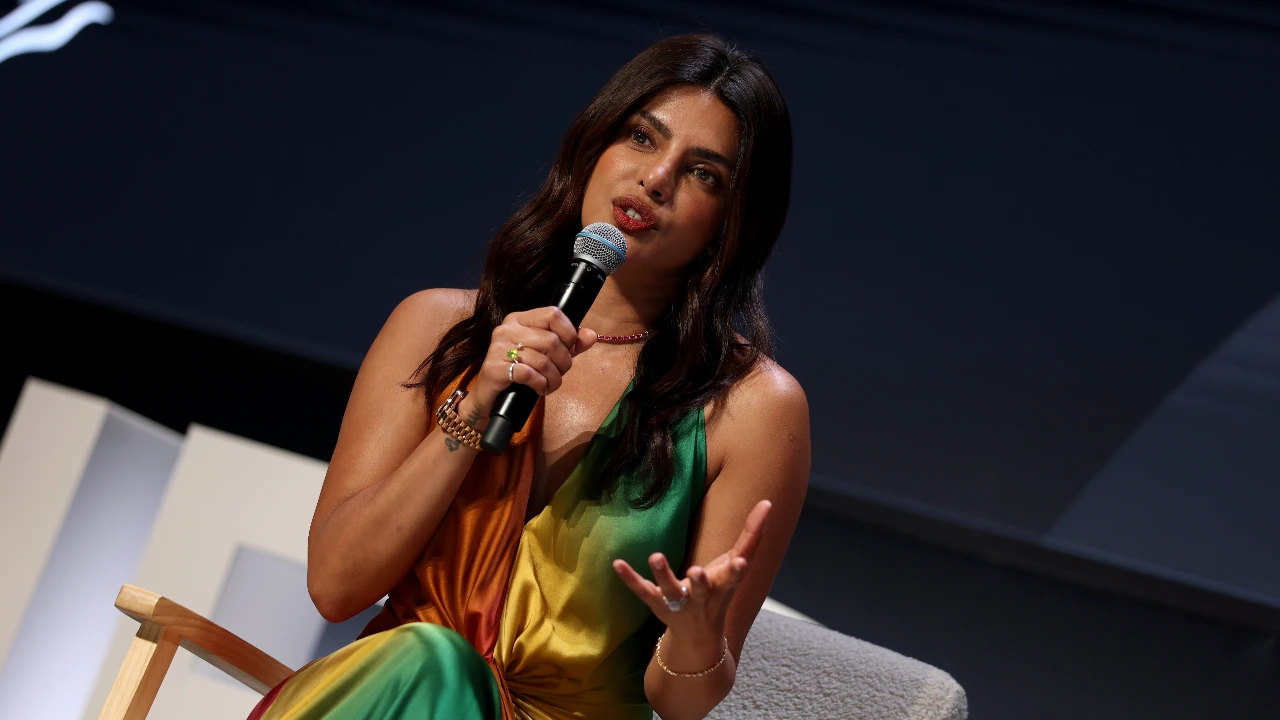
 Priyanka Chopra Jonas
What makes a story travel across borders without losing its soul? According to Priyanka Chopra Jonas, it isn't about chasing universality or following trends. It is about authenticity, emotional truth and the courage to evolve.
In conversation with Leah Wyar, president, entertainment, beauty + style group, People Inc., at the Cannes Lions International Festival of Creativity 2026, the actor, producer and entrepreneur reflected on a career spanning 26 years, speaking candidly about reinvention, audience relationships, producing films, confidence and balancing ambition with motherhood.
Never taking the audience for granted
Chopra believes longevity begins with respecting audiences and constantly evolving.
“The most important thing is to not take your audience for granted, not take the love and attention that they give you for granted, to constantly evolve in every project that you take on.”
She added that retaining attention requires a continuous process of reinvention.
“Keeping people’s attention is a really tough job, and you can only do it through evolution and evolving yourself as an artist, as an entrepreneur, as a person.”
Authenticity, she said, remains the anchor behind every decision.
“I've always wanted to be authentic to myself in everything I do.”
In an era where audiences know celebrities beyond their on-screen personas, Chopra said vulnerability has become more valuable than perfection.
“That emotional connection with your audience comes from being able to accept and be real about the fact that I'm doing my best.”
Summing up her own philosophy, she said: “I'm just a girl doing a job.”
Choosing storytelling over trends
As producer of films like The White Tiger and projects under Purple Pebble Pictures, Chopra admitted that success remains unpredictable.
“Movies are sort of like lightning in a bottle,” she said, adding that she avoids trend-chasing.
“I try not to follow trends, because that's really hard. A trend is interesting right now. It might not be interesting next week, and even more so, next year - which is probably when the movie will come out.”
Instead, she judges stories by emotion. “How does this make someone feel? So it has to be an emotion.”
The films people remember most, she said, are those that stay with audiences long after they end.
“My favourite movies are the ones that you kind of talk about later, it makes you feel something.”
Reflecting on global successes like Citadel and Heads of State, Chopra likened a good movie to a cultural event.
“A good movie is a movie you'll invest two hours – three, if its an Indian movie - and you remember it. But I think an event is something that you discuss, that kind of moves culture.”
According to her, such works create communities.
“It creates a sense of community. You want to talk about it with people, you want to watch it with friends.”
On the streaming revolution
Streaming, she contended, has fundamentally transformed entertainment.
“Evolution is hard, but I think it's just so much fun and interesting to see how entertainment has changed.”
Far from lamenting disruption, she finds it invigorating. “I find that (OTTs) very exhilarating. I find it challenging, but I also like a challenge.”
Chopra recalled how Indian cinema was once considered incapable of matching Hollywood's reach because of language barriers.
“I think streaming changed that so much,” she noted, while adding that the pandemic accelerated audiences' willingness to embrace subtitles and global content.
Pointing to global content like Squid Game and Parasite, she said: “It's a wonderful time for people who are creative, for creators, for artists. Today, ideas matter more than geography. Ideas are your currency.”
Choosing partnerships
Speaking about brands and endorsements, Chopra emphasised authenticity over money.
“I only align with brands that I use in my real life, that are part of my existence, that I admire, whose brand values I align with.”
“I like to associate with the best,” she added.
Her philosophy extends beyond brands.
“I invest in myself with filmmakers that I work with, movies I take on, partnerships that I take on. I like to level up.”
Motherhood and the next reinvention
Now navigating life as a mother, Chopra admitted she is reassessing priorities.
“I literally feel like I'm at the precipice of kind of trying to figure out what my next decade looks like. I'm really, really selective about the time that I spend and who I spend it with.”
While professionally she hopes to bring the variety she enjoyed in Indian cinema to her English-language career, personally, she is discovering the realities of being a working parent.
“I'm trying to navigate, just like everyone, what life is like as a working parent now.”
Cultivating the art of confidence
Perhaps her most resonant takeaway was about confidence, when asked if there are moments of doubt she experienced even at this stage of her career.
“I always say this - it's like going to the gym when you want the right physique or the right body. One has to work on it. Confidence is a choice that one has to make. It's not with you all the time. Sometimes you will be nervous doing the most mundane things.”
Chopra initially subscribed to the popular ‘fake it till you make it’ philosophy, but now she believes one can't fake confidence. Instead, she advocates building an ‘imaginary backpack’ filled with the tools that one needs to gain confidence – such as experience and skills.
She also underlined that anybody saying that they are naturally confident is not true.
Recalling her first Hollywood audition, she said, “When you get that feeling and doubt creeps in, you have to be able to access the confidence in your imaginary backpack. I always carry with me all my tools that I need.”
“I remind myself of my value - what I bring to the table every time I walked into a room. So confidence is practice and more practice,” she signed off.