
 Subscribe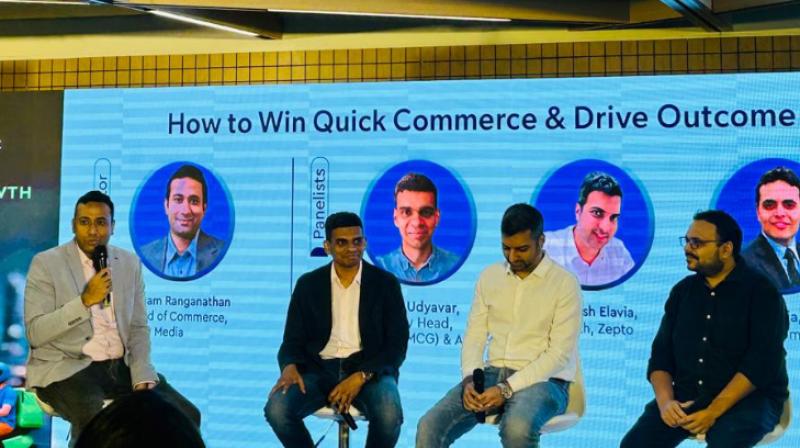
 From left: Sriram Ranganathan, Shashi Udyavar, Pawrush Elavia and Nitin Narsaria.
At the WPP Media x Meta Playbook launch, panellists discussed driving growth and loyalty in India’s fastest-moving retail channel.
On 5 December, WPP Media and Meta released the CPAS Playbook for retail and quick commerce in India, revealing how the consumer journey is shifting from planned baskets to instant, inspiration-led buying.
The launch brought together two panel conversations with leaders from WPP Media, Meta, and brands operating inside the quick commerce ecosystem.
They spoke about what’s working, what needs to change, and how brands can build the right funnel to win on platforms like Blinkit, Zepto and Swiggy Instamart.
The first panel featured Shashi Udyavar, industry head – CPG and alcobev, Meta; Pawrush Elavia, growth lead, Zepto; and Nitin Narsaria, head - e-commerce, Sun Pharma.
The discussion was moderated by Sriram Ranganathan, head - commerce, WPP Media.
Quick commerce isn’t a separate channel
Udyavar opened the conversation with a clear stance on how brands need to approach the space. He said, “You have to find ways to win on quick commerce. Don’t treat it as an isolated channel. Don’t just rely on people already on quick comm, which gives leeway to crack all three marketing funnels. The first thing I would like to say is that quick commerce is not optional anymore for anyone. Whether it is fashion or FMCG, you have to find ways to win on it.”
He went on to state that quick commerce shouldn’t be treated as an isolated channel. “Sometimes, in the intent to drive really high sales by capturing the lowest-hanging fruit, brands focus only on consumers already on quick commerce apps, not new customers. The rules don’t change. You still need to use your marketing strategies, use more of the audiences you know, and don’t just rely on people oriented to these platforms. Keep tapping into buyers outside,” Udyavar pointed out.
Udyavar believes in focusing on all three marketing funnels for this outreach. He remarked, “That means you continue to create strong upper-funnel, mid-level, and bottom-level campaigns. At the bottom funnel, you have the opportunity to win on quick commerce, but you’re capturing people who come for offers and discounts, very tactical buyers, and if you chase only the short term, they might take away your long-term wins. So my take is: if you want to win with quick commerce, hold on to the brand-building principles and think long term.”
From micro-moments to first choice
Elavia spoke about how quickly consumer behaviour has evolved on these platforms. He shared, “Quick commerce has evolved massively. I’ve been at Zepto for one-and-a-half years, and I’ve seen transformations that I haven’t seen in a decade working in different companies. The way we have moved is that people’s perception of quick commerce has also changed a lot.”
He then went on to say that there is a need to create occasions and moments for consumers to come to quick commerce.
“We are talking about micro-moments and things like Black Friday. Platforms like ours are opportunities for brands to show users that we can deliver within 10 minutes. Gone are the days when quick comm was an afterthought, when someone didn’t have something at home and switched to us. Now people are considering quick commerce as the first choice for gifting and many other occasions,” Elavia said.
“The opportunity for brands is that platforms like Zepto, Instamart, and Blinkit have grown massively, and users are pouring in,” Elavia added. “The question is how brands use that growth. How do you get more users and move them to your own app or site? That’s where CPAS comes in: brands using their own inventory, using their own thinking to acquire users while leveraging quick commerce delivery. It’s a strong collaboration between brands, Meta, and the platforms.”
Availability first, then premiumisation
Narsaria described what matters inside the funnel from a brand perspective. He remarked, “Any brand, the first thing they need to solve is quick availability. Assuming that’s taken care of, we need to bring in users. In categories with a high rate of repeat, a brand also needs to go for premiumisation, thematic days, and different occasions, so consumers come back to the app and shop for our brand while we get products to them in the shortest possible time.”
Narsaria added that all said and done, from a brand point of view, ROI is very important; tools like CPAS, which bring non-consumers to the app and give that upper hand as metrics, are critical. “Once we’ve sorted availability and the funnel, and we get users into the relevant spaces, even down to micro-neighbourhoods like Khar or Punjab, we start seeing real adoption. These are the two most important pillars for any brand that wants to consistently win on quick commerce,” voiced Narsaria.
The metrics that matter
The conversation then moved to measurement. Narsaria was direct about how brands should frame performance. He shared, “So all said and done, ROAS will be a key metric forever, for both brand and agency. But customer retention and lifetime value matter because the first consumer you acquire on Quick Comm, you acquire at a loss. A lot of platforms have reduced or stopped delivery fees, so if someone buys something for INR 100, you actually overlap costs. It’s critical that once you acquire the customer, they come back again and again. Retention, lifetime value, ROAS, and conversion are the metrics to track daily. If we get these right, we’re sorted.”
Elavia added a platform view.
“For quick commerce platforms like us, lifetime value matters most. We spend a lot to acquire users. We know we can do that because of the options we offer and the frequency of purchase. Our focus is retention and frequency, which drives lifetime value. Different metrics apply to different businesses. For platforms, it’s about acquiring users and growing the funnel. We’re competing with 100–120 million users on Amazon and Flipkart. Our headroom is big. The question is: how do we get everyone on e-commerce to try quick commerce and eventually make all their purchases here?" shared Elavia.
Udyavar explained why ROI can’t be a blunt instrument. He said, “ROI is often a blanket term used to push back against innovation. I’d make it more category-out than advertiser-out. Even within WPP Media brands, the way Mondelez or P&G operate is different because they have different tasks. Some clients want to test the effectiveness of first-party data with quick commerce. They don’t care only about a pure ROI number. If it’s a new brand and you want to amp up discovery, you’re not looking at simulated ROI; you’re looking at how many new users you added, what searches were influenced. The beauty of quick commerce and collaborative ads is that you can tailor the metric to your brand."
Udyavar went on to share that brands need to make sure they are ready to deliver ROI. He shared, “If you take a low-value product and switch on a couple of ads expecting ROI, you’re setting the brand up for failure. Take a long view, even for ROI.”
Creative, AI, and partnerships
The discussion also touched on the role of creativity and AI. Elavia explained how Zepto uses tooling to make discovery work. He shared, “We have over 10,000 products to sell, and we don’t know what a non-user is interested in. We rely a lot on Meta, AI, and other tools to understand that. We use catalogue-shopping from creative into video, into a 10-second piece. For a platform like Zepto, Blinkit, or Instamart, it makes sense to show a range of options across categories.”
Elavia pointed out that they use a lot of generative AI to turn a product shot into targeted content.
“A sports fan sees something relevant. It’s a challenge because to acquire users, we have to rely on external intelligence. For users already acquired, we use historical data for remarketing at the right moment, the first week of the month, when grocery energy is high, for example,” he remarked.
Udyavar pointed to a shift in how brands communicate inside collaborative ads.
“Creatives are the most important, and AI gives the opportunity. Another big shift is brands using creators in partnership ads, that’s my favourite example. When Mondelez used actor Ishaan Khatter to sell Bournville, it delivered the highest ROI, 2x Bournville with a creator connection. At the bottom of the funnel, there are lots of communication opportunities. Using bespoke creators at the mid-funnel can make a real difference,” Udyavar remarked.
Narsaria closed the discussion with a brand-side perspective.
He concluded, “From a brand point of view, a lot of things happening with Meta and platforms are opaque, even though we try to understand what’s coming, how creative is changing, how targeting works. Everything gets revised every few months in quick comm. With Zepto, because we partner deeply, we’ve created partnership ads. It’s critical to understand what the long-term looks like, what the next 3–6 months look like, what the competition will do, and what new tools you have in creative, in targeting, and what’s worked in other categories. Then you adapt it for your brand and see if it creates impact. With quick commerce, many things are still trial-and-error; the same playbook doesn’t apply to all brands.”