

 Subscribe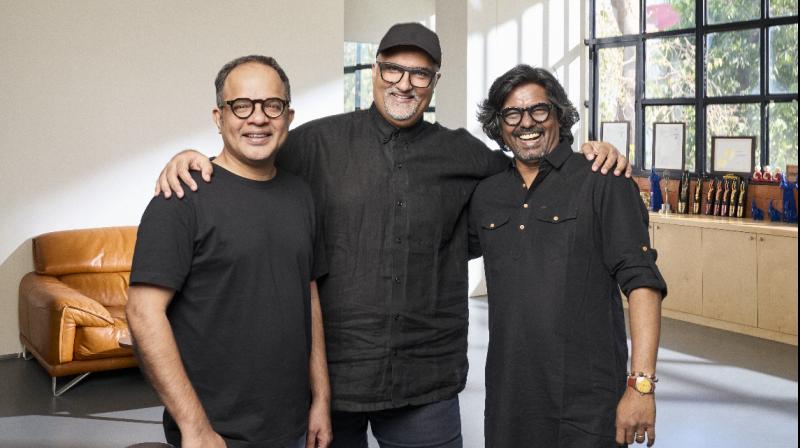
 From left: Vijay Sawant, Dharam Valia and Mahesh Gharat
There’s a moment most people in advertising hit after a decade or two.
One has seen enough pitches, enough decks, and enough launch films to know the drill by heart. For some, that familiarity becomes comfort. For others, it becomes a prompt to go deeper into the parts of the work that still feel alive.
Hungry Films was born from that instinct.
For Dharam Valia, co-founder and executive producer, and Vijay Sawant, co-founder and film director, Hungry Films, the idea wasn’t to escape advertising.
It was to lean further into the part of it that continued to excite them. Both had spent decades inside the system, crossing paths with Ogilvy in different capacities and working on brands across categories, scales, and expectations. What consistently pulled them in was the journey of an idea — from imagination to a film that could speak for itself. Not the noise around it, not the packaging, but the act of making something that worked emotionally and commercially at the same time.
“After a point, you start asking where you actually want to spend your energy,” Dharam said. “Advertising is exciting, and it’s demanding. Within Ogilvy, film production was the space that excited us the most creatively. That’s where Hungry really began.”
In 2014, they took the leap and started Hungry Films — driven more by instinct than a long-term blueprint.
Close to 12 years later, Hungry Films has built a body of work that resists easy categorisation. From entertaining visual spectacles to deeply emotional storytelling, from massive corporate films shot across multiple locations to immersive tourism campaigns, from five-second spots long before short-form became fashionable to technically obsessive TVCs executed without visual shortcuts, their reel feels intentionally unpredictable.
That unpredictability is deliberate.
At a time when production houses are increasingly pushed to move faster and adapt to rapidly changing platforms, Hungry Films sits slightly out of step. The work doesn’t chase formats or algorithms. It chases feelings. That tension between speed and craft is where their films tend to stand out.
Advertising roots, brand-first thinking
One of the quiet strengths of Hungry Films is that it never pretended to be anything other than what it is: a production house deeply shaped by advertising. The team understands why a script exists, what a brand is trying to solve, and what’s at stake when a client signs off on a film.
“We’re still brand-first,” Vijay explained. “The film has to work for the client. Someone is putting time and money behind it. Maybe it’s a bit old-school, but that approach shows up in our work, even when the visual language is experimental.”
The values are old-school; the methods are next-gen.
That grounding allows them to push boundaries without losing sight of the brief. It’s why visually immersive worlds like Coke Pujo or Asian Paints can coexist with something as restrained and intimate as St. Jude’s The Impossible Choice. The ambition isn’t to show range for its own sake, but to find the right form for each story.
Vijay put it simply: “We don’t think in terms of formats or durations or trends. We make the film the way it needs to be made. If it fits into whatever strategy exists around it, great. If not, the film still has to stand on its own.”
Over time, that clarity has translated into repeat relationships. Agencies return not just for execution, but for problem-solving — knowing that Hungry Films will question a script when needed, push an idea when it matters, and still land the film with discipline and care.
Coming from the agency side himself, Mahesh Gharat brings a complementary perspective. “I understand why a script exists in the first place,” Gharat said. “At Hungry, the focus is always on translating that intent honestly on screen, without diluting it.”
Why being ‘Hungry’ stuck
The name Hungry Films wasn’t born out of a branding workshop or a manifesto. It came from instinct.
“There wasn’t a deep meaning when we picked it,” Dharam admitted. “We just wanted something that stayed with you. I always liked the phrase ‘hungry and foolish.’ In a creative profession, you have to be a bit of both.”
Over time, the word took on its own meaning. Not hunger for scale or visibility, but for work that leaves an impression — work that makes the viewer want a little more.
“If a piece of work doesn’t excite us emotionally, it’s hard for us to commit to it,” Vijay said. “That instinct hasn’t changed from the early days to now.”
Dharam agreed. “The hunger we had at the start is the same today. If anything, the stakes are higher now because expectations are higher. Our responsibility to the script only grows.”
Finding shape through trust
Hungry Films didn’t arrive fully formed. The early years were about building trust — with agencies, with clients, and within the team itself.
“It didn’t happen overnight,” Vijay recalled. “Once that trust came in — clients trusting agencies, agencies trusting us — it gave us the space to stretch creatively. Those early films started giving Hungry its shape.”
A key part of that evolution came when Mahesh Gharat joined Hungry Films as director in 2022, sharpening the company’s creative sensibility. With decades of creative leadership behind him, his transition into directing brought a strong alignment of idea and execution.
One of the defining early works that shaped Hungry’s trajectory was Toys, created by Ogilvy & Mather Mumbai for the Government of Madhya Pradesh and released in May 2016.
Conceptualised by Ogilvy, the film was creatively led by Mahesh Gharat as executive creative director, produced by Hungry Films and directed by Vijay Sawant. The film went on to become a reference point for how craft-led storytelling could elevate tourism communication without leaning on spectacle.
Even today, the founders insist that very little has changed in how they approach work. The experience helps. The confidence is earned. But the instinct remains.
“Experience gives you perspective,” Gharat said. “You stop chasing effect and start protecting intent.”
Hungry Films doesn’t overthink what a production house should look like. It focuses on what films should feel like. The brand, for them, isn’t a logo or a tone of voice. It’s the work itself.
“If there’s one thing to take away,” Dharam said, “it’s that. The brand is the craft. The rest is noise.”
In a business that rewards visibility, Hungry Films has chosen restraint. In an industry that often confuses consistency with repetition, it has chosen curiosity. And at a moment when production risks becoming commoditised, it has doubled down on the one thing that still can’t be automated — taste.
Quietly, over time, that focus has done the talking.
To contact the team, mail [email protected].
This feature first appeared in the January issue of Manifest. Get your copy here!