

 Subscribe
 TV ad volumes registered an 11% year-on-year decline in 2025 versus 2024
After a relatively stronger 2024, television ad volumes softened in 2025, registering an 11% year-on-year decline in ad volume, according to the TAM AdEx 2025 Television Advertising Recap report, signalling a more cautious advertising environment.
The slowdown was uneven across the year, as Q2 2025 recorded a 6% sequential growth over Q1. Momentum weakened again in Q4, with volumes declining 10% compared to Q3, pointing to cautious year-end spending.
Despite the overall decline, FMCG categories remained the backbone of TV advertising. Food and beverages led with a 21% share of ad volumes, followed by personal care and personal hygiene at 15%, and services at 14%.
Notably, the top six sectors retained their rankings from 2024, underscoring television’s continued strength as a mass medium for established consumption categories .
At a category level, toilet soaps, toilet/floor cleaners, and washing powders/liquids continued to dominate, retaining their top three positions from 2024. Together, the top ten categories accounted for 32% of total ad volumes in 2025.
A standout shift came from retail outlets–jewellers, which climbed from 16th position in 2024 to 9th in 2025, signalling renewed retail confidence and higher-value purchase communication on television.
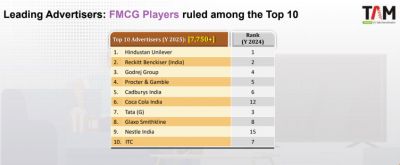
The top ten advertisers accounted for 44% of total ad volumes, with Hindustan Unilever retaining its leadership position at 14% share. Reckitt Benckiser (India) emerged as the most dominant brand owner, with seven of the top ten advertised brands, led by Dettol and Harpic franchises.
While overall volumes declined, over 170 categories registered positive growth in 2025. Toilet/floor cleaners saw the highest absolute increase at 13%, while vocational training institutes recorded the sharpest percentage growth at 2.5x over 2024.
E-commerce-linked categories, including online shopping and financial services, also posted double-digit growth.
Channel genre distribution remained remarkably stable year-on-year. GECs and News together accounted for 56% of ad volumes, while the top five genres contributed over 92% of total advertising in both 2024 and 2025.
This consistency highlights that advertisers continue to rely on television’s proven ability to deliver scale through a narrow set of high-impact genres.
One of the more dynamic areas in 2025 was movie-linked co-branded advertising, which clocked over 570 hours of ad volumes.
Brands associated with films such as Pushpa 2 alone accounted for 23% of co-branding volumes, reflecting how television continues to serve as a launchpad for mass pop-culture moments.