

 Subscribe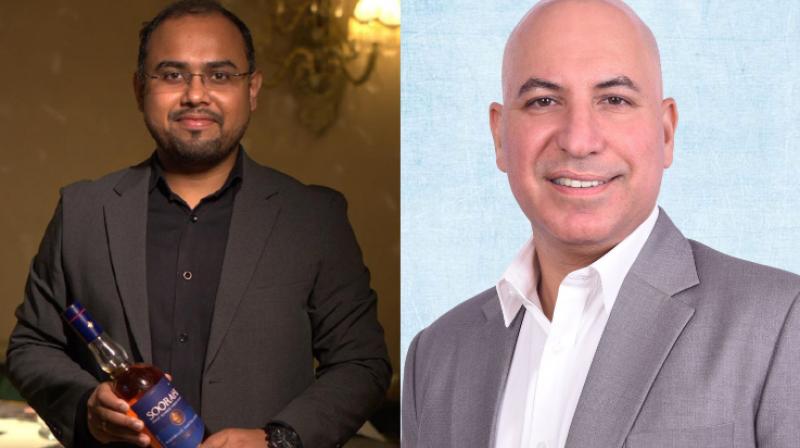
 Subrajit Majumdar (left) and Ankur Sachdeva
When Uppal Brewers & Distillers (UBD) launched its first brand in January 2025, it entered a category shaped by regulation, legacy, and long-established global players.
Leaning into culture, the company is looking to carve out a distinct space not by leaning into culture.
Through humour-led, observation-driven campaigns, UBD’s whisky brand Soorahi aims to position itself less as a product on a shelf and more as a presence in everyday moments.
That humour-led approach is evident in its latest campaign, 'Soorahi Love, Laughter and Shaadi ka Chapter', featuring stand-up comedian Appurv Gupta, which takes a witty swipe at the realities of the wedding season.
Instead of romanticising weddings, the two-film campaign reflects how many young adults actually experience them, as a gauntlet of awkward questions and unsolicited advice. By choosing to laugh it off rather than sermonise, Soorahi finds levity in these moments, using humour and cocktail-led storytelling to help guests navigate the season without making a statement out of it.
Offline, the brand has also rolled out mock wedding invitation cards that look authentic at first glance before revealing a tongue-in-cheek twist, and the campaign will culminate in a live comedy-and-tasting experience on 17 January.
To further understand the brand’s campaign, the market gap they saw while building the brand, and the importance of storytelling and packaging, we caught up with Ankur Sachdeva, CEO and co-founder, UBD, and Subrajit Majumdar, head - marketing, UBD.
Edited excerpts:
Through UBD, what was the gap you saw in the market that you were trying to address?
Ankur Sachdeva (AS): My business partner had wanted to enter alcobev for a while, but things only really moved in late 2024. I joined in December, and we launched our first product on 10 January 2025, so we’re close to our first anniversary.
From the start, we saw a clear gap. Apart from single malts, there wasn’t really a blended premium or luxury Indian whisky. That felt like an opportunity.
When we worked with our blender, we also realised Indian consumers weren’t getting a fair deal. Malt content had been dropping over the years, and the only story many brands were telling was that they were 'a Scotch.' But Indian consumers have grown up; they look beyond the label and want substance.
And it wasn’t that hard to make a better product. Once we saw that, we knew we were onto something, and the last year has only reinforced that belief.
As a new company, how have you approached brand-building, and how has the Uppal Group’s backing helped in terms of awareness, credibility, and scale?
AS: The Uppal Group today operates largely in luxury real estate, so they have a strong understanding of what premium and luxury mean, consumer insight, style sensibility, and quality benchmarks. I bring over two and a half decades of alcobev experience. So it became a complementary partnership; I brought domain knowledge, and they brought an understanding of the premium consumer, which made the transition into this space quite natural.
Subrajit Majumdar (SM): From a marketing perspective, the fundamentals are the same across categories. With the backing of the Uppal Group, our first focus was clearly defining the brand’s positioning and archetype. The group’s visibility gave us some initial awareness and trust, especially in NCR, but after that, the brand had to stand on its own. And that’s what it’s done.
What has been the biggest challenge in building a brand in such a tightly regulated category, especially when it comes to distribution?
AS: The biggest challenge was entering a category where single malts had already opened the door, and most competitors had decades of international lineage. We were coming in with an Indian blended whisky, so there was a real question of how that would be received.
That tension pushed us to be product-first and to over-deliver on quality. We built a strong product with a clear, accessible story. Even the name Soorahi is easy and memorable. Once that landed, things started falling into place.
In this category, one can’t always advertise the product or sell it directly because of regulatory constraints. So, how do you define a good marketing strategy in that context?
SM: A good marketing strategy is still a comprehensive exercise, even here.
For us, it started with defining not just the brands, but what UBD stands for as a company: its persona, values, intent, and how we wanted to approach the market. Because we’re a startup and Soorahi was our first brand, that clarity was essential.
From there, we identified the segments we wanted to play in and defined the positioning and archetype for each brand. Soorahi, for instance, stands for the spirit of discovery — enjoying the journey of life and those moments you want to pause and savour. That’s the audience we speak to.
Given the regulatory limits, we use a mix of digital, social, retail, and on-ground activations. In the first year, we were also learning what works on which platform and how consumers respond. That combination has held up well so far, and that’s what an effective strategy looks like for us in this category.
Coming to the recent campaign launched, what was the thinking behind using humour and partnering with a comedian?
SM: Soorahi is rooted in the idea of the journey, “Soo” meaning good and “Rahi” meaning traveller. It’s about being a companion through everyday life, whether that journey is internal or physical. At its heart, the brand is about celebrating real moments, the things people actually experience, relate to, and recognise.
This campaign is part of our digital-first approach. Humour isn’t the idea; it’s the medium. The real focus is the wedding season, especially in North India, a time when people try new brands, and whisky performs well, particularly in winter.
So weddings became the cultural moment we built around, and humour was our way into that conversation. If you look at the films, humour is just the first layer. The larger idea is to tap into real moments in people’s lives and show how a good whisky can naturally be part of them. That’s what the Soorahi campaign is about.
In the alcobev category, packaging is often the first, and sometimes the only, advertising a consumer actually sees. So what’s the approach there?
SM: I think of packaging as a first impression; it either draws you in or it doesn’t. So we’ve put a lot of thought into the details. With Soorahi, for instance, the white canister and compass motif reinforce the idea of journey and direction, with elements like night, day, mountains, and water woven into it.
It’s also important that packaging delivers value. We want consumers to feel pleasantly surprised; that sense of “this looks more premium than I expected at this price” is what often pushes people to try it.
We’ve evolved the look based on feedback. It started calmer and more subdued, then moved to a bolder white canister with refined colours, gold detailing, and better finishes. Even the bottle details like the North Star etched on the closure and the wave at the base are part of telling that story.
The response tells us it’s working.
AS: For me, packaging is the promise, and the liquid is the delivery. With Soorahi, the story isn’t forced onto the pack; it’s built into the brand itself, from the name to the bottle shape to the compass and North Star. That’s why it feels authentic, and that’s what people respond to.
How important are live events and on-ground experiences in building brand awareness, especially at this stage of the business?
SM: They’re extremely important.
Live events are where we get trials, first feedback, and a real sense of how consumers are responding to the blend, the packaging, the communication, and the brand. In many ways, they work like live focus groups.
We’ve been selective because we currently operate only in brown spirits, with two whisky brands. In 2025, we started with a consumer exhibition at Pragati Maidan, Delhi, the first time alcohol sampling was allowed at a large-scale government event, where over 2,000 people sampled Soorahi. We then participated in Alcove India in Delhi, and later in Brews & Spirits, Bengaluru, where more than 1,000 people tried both Soorahi and Madhvan.
These experiences gave us confidence and direction. As the portfolio evolves, we’ll explore other platforms as well.
Looking ahead to the coming year, what’s one shift or consumer behaviour pattern you see that will help the alcobev category grow in India?
AS: Whisky has remained about 63–65% of the market for decades, even as other categories have had their moments.
What’s changing is within whisky. Single malts are growing, and premiumisation is happening across price points. Consumers want better quality and better experiences. Brands that respond to that will do well.
SM: India isn’t a saturated market. It’s one of the fastest-growing consumption markets in the world.
There’s no degrowth here; what’s changing is how people drink. It’s becoming more experience-led and intentional. That means brands need strong fundamentals in brand, storytelling, packaging, and liquid quality to last.
Lastly, for both of you, what can we look forward to from UBD, and are there any expansion plans going forward?
SM: 2025 was our foundation year. In 2026, we’ll at least double our footprint across North, West, and East India, which will change how we think about media and brand-building.
AS: We’re also introducing a third product in 2026. The long-term vision is to build a premium-only, pan-India alcobev company. The trajectory is upward.