
 Subscribe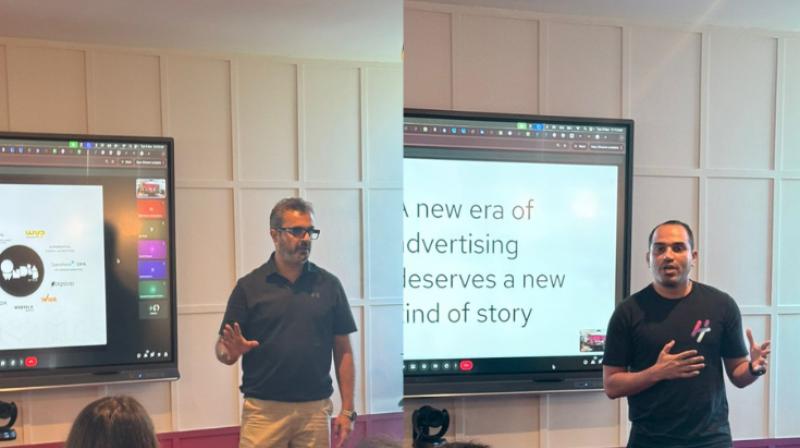
 Rakesh Hinduja (left) and Meher Patel
Wondrlab Network wants the industry to stop talking about decline and start talking about scale. At a media roundtable at its Mumbai headquarters, the network laid out how Hector, its homegrown commerce-media platform, has moved from an internal tool to a global growth engine.
“It’s not the end of an era. It’s the start of one,” said Rakesh Hinduja, co-founder, Wondrlab Network, addressing concerns around a 'shrinking' industry. “We’ve spent more than two decades in this business and always knew what needed to change. India is fabulous in talent and technology. Wondrlab was built to bring those two strengths together in a full-funnel, platform-first network.”
Meher Patel, founder, Neon and Hector AI, underlined that Hector was never imagined as a classic top-down SaaS build.
“The difference is we built Hector as practitioners, not just developers,” he said. “The same floor where campaigns are run is where features are conceived. We faced the performance marketing problem every day, thousands of SKUs, real-time shifts in bids, budgets and attribution, and then built the tech to solve it at scale,” he said.
At the roundtable, Wondrlab disclosed that Hector now manages more than INR 3,500 crore in ad investments and powers performance for over 350 brands across ecommerce, quick commerce and digital retail.
The platform has been ISO-certified and SOC-compliant, signalling it is engineered for enterprise-grade deployment with full data governance and security.
Over three years, Hector has been taken from an internal optimisation layer for Neon’s managed-service clients to what the network now describes as a core pillar in its full-funnel ecosystem, spanning content, creative, experiential, influencer marketing, CRM and tech-led business transformation.
The model is intentionally platform-first and mirrored across geographies, with local teams driving adoption in each market.
A key context for Hector’s rise is the explosion of retail media. Platforms such as Amazon, Flipkart and Blinkit now anchor both product discovery and transaction, enabling closed-loop attribution and measurable return on ad spend. Patel framed this as a structural shift in how brands, especially challengers, think about growth.
“Challenger brands don’t start with a big awareness film,” he said. “They start with profit-first marketing — investing every rupee where they can see the revenue back. Commerce media makes that possible because the search, the click and the purchase all happen on the same platform.”
Hector plugs directly into this reality.
Through API integrations where available and proprietary data ingestion where they aren’t, the platform ingests performance data from marketplaces and quick commerce platforms, then uses machine learning and automation to manage campaigns across thousands of SKUs.
It adjusts bids, budgets and targeting at a granularity that human teams can’t match, while providing a single interface for brands that would otherwise be juggling dashboards and spreadsheets across Amazon, Flipkart, Blinkit, Zepto and others.
Patel pointed out that for large advertisers, the complexity has outgrown manual methods. “If you’re managing hundreds of campaigns and thousands of targeting entities, each with its own budget, bid and performance pattern by the hour, no human team can compute that in real time,” he said. “That’s the vacuum Hector stepped into. We’re optimising ad dollars, not just visualising them.”
While India remains Hector’s launchpad, Wondrlab has already taken the platform into the United States and Japan, two markets where retail media and marketplace advertising are rewriting marketing economics. The US, in particular, has quickly emerged as Wondrlab’s second major growth engine, the duo stated.
Hinduja said that despite having far fewer clients in the US than in India, the revenue contribution is already at par, driven by larger ad budgets and a faster appetite for deep-tech SaaS adoption.
Subscription and managed-service fees in the US, he noted, are roughly three times Indian levels, lifting Hector’s global revenue mix even as the bulk of its client base remains in India.
The network’s leadership sees this as validation of its 'platform-first network' thesis: build proprietary technology close to where the problem is felt, prove it with Indian challenger and enterprise brands, then scale it into mature markets where retail media is already mainstream.
For Hinduja, that story loops back to the bigger industry narrative. “Our industry gets questioned on how much impact we really drive,” he said. “We’ve celebrated the TVC for decades, it will always matter in India, but the real story now is from connect to conversion. When platforms like Hector show exactly how advertising drives commerce, that’s when this business stops shrinking in people’s heads and starts expanding in reality.”
From a small internal experiment to a scaled, ISO-certified, SOC-compliant platform operating across India, the US and Japan, Hector is now positioned as one of the central levers in Wondrlab’s ambition to be India’s first truly full-funnel, tech-and-creative network.
Inside the company at least, platform-first marketing isn’t framed as a future trend anymore, it’s treated as the present tense of how growth gets done.