

 Subscribe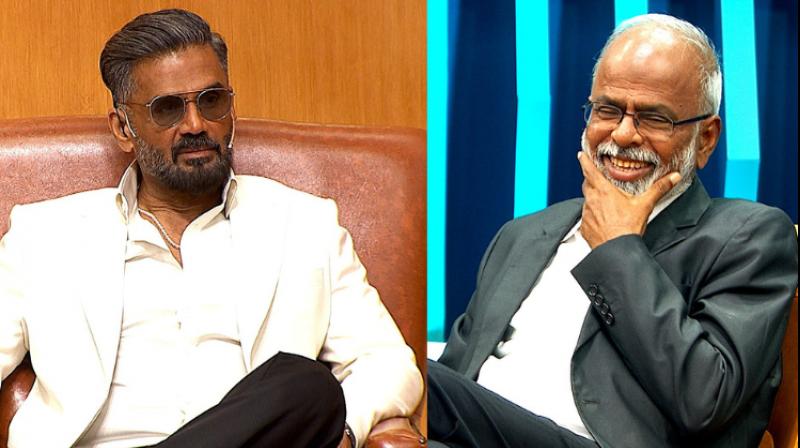
 Suniel Shetty (left) and A Velumani in Bharat Ke Super Founders
While format-driven pitching shows are hardly a novelty, Bharat Ke Super Founders, launching on 16 January on Amazon MX Player, promises to strip away the 'scripted' theatrics of startup reality shows and move beyond ‘deal drama’ in favour of a reality check.
Anchored by actor-entrepreneur Suniel Shetty, and backed by an INR 100 crore plus investment pool, the show features a panel of business tycoons and experts from the venture capital industry, including A Velumani (creator, Thyrocare and director, AVMSmile), Shanti Mohan (founder and CEO, LetsVenture Trica), and Ankur Mittal (partner, Physis Capital and co-founder, Inflection Point Ventures).
In this freewheeling conversation, Shetty and the tycoons reveal the show’s unique ecosystem-driven approach, the shift from metro-centric to small town founders, and why the show’s success will be measured by its founders' 'traceability' and growth in the years to come, rather than just overnight viral fame.
Edited excerpts:
Startup pitching shows inevitably invite comparisons with existing reality formats like Shark Tank. At its core, how would you describe the most fundamental difference between Bharat Ke Super Founders and the shows we have seen before?
Suniel Shetty: First and foremost, we need to acknowledge that, whether it is Shark Tank or Bharat Ke Super Founders, in a country like ours, we need 100 more such shows. Because that's the sheer volume of ambition and founders there are in India, and the country needs that from a growth perspective.
Now, let's talk about the two shows. We've all seen Shark Tank. It's a highly successful international show that has come to India and is performing very well. But it's primarily about a single interaction between a founder and an investor. Here, we have built a multi-pronged support system: the founder, the investor, the market, which is a unique segment, mentorship, and grants. So it's this success ratio when a founder comes in, his chances of succeeding, not only from an investment perspective but even otherwise, are 80-85% plus. Other than that, all of us are very clear, especially after executing our first season, that for us, the success of the show is when on the next season, we’ll have our successful founders come and showcase the growth and the journey that they've been through. That is the differentiator for me.
A Velumani: I am 100% sure of one thing: it is not scripted. In the olden days, before a marriage, the boy did not see the girl, and the girl did not see the boy. Our interactions were exactly like that. We had not seen the entrepreneurs, and they had not met us before. It was absolutely ‘taaza’ (fresh) when they presented. We are here to analyse and ask tough questions, but we are not there to belittle anyone. We give suggestions; it is more of mentorship than investment. And more of telling us about their dream, while questioning its liabilities and scalability. It has all the ingredients a family needs in their living room, because every episode brings in a new perspective. I am a mass mentor, and this show gave me the opportunity to reach rural India. We are not just looking to create billionaires; we want to create multi-billionaires. Bharat Ke Super Founders will give rise to many such ‘micro entrepreneurs.’ Today, after a month of understanding, analysis, and assimilation, we believe we have a show which India needs for atleast the next 10 years, if not more.
Ankur Mittal: Looking at it from the prism of an impartial viewer, the show’s conceptualisation is what stands out. They have brought together a combination of investors who have proven success stories or who come from the business of investing. At the same time, we also understand the power of mentorship; we are experienced enough to understand that capital is only one of the many problems a founder faces. In fact, for an experienced founder, capital is often the easiest problem to solve.
Then introduced a concept of ‘market,’ which’s a brilliant sanity check. In the coming episodes, you will see the market segment questioning the tycoons on the valuations we are offering. They represent the founder’s perspective, and sometimes, where we as investors might be hesitant, the market sees immediate value and is willing to acquire that business. That interplay is entirely new to Indian television.
Also, I don't think any show has a role like what Sunil (Shetty) sir has performed on this show. I gave him the title of ‘Big Boss’ for he isn't just a host; he is a mentor to both the tycoons and the founders, acting as an intermediary. He understands the pressures of being a founder because he has been one many times over and has seen both success and failure up close, and that perspective is very important. So there’s this kind of interplay happening, we saw a lot of human emotion, heart, brain, intent - everything coming together. That is what people will find different here.
What specific gap did you feel this show fills, and why is now the right time for a more credibility-led format?
Shanti Mohan: It isn’t about a ‘gap’, there is a need. One or two shows aren't enough for the 1.4 billion Indians aspiring to be entrepreneurs. From a format perspective, it is a very inclusive ecosystem for founders. A founder might get an integrated equity and debt instrument, or they might get a grant if they requires it; one will get mentorship.
As tycoons, we have promised to work with these founders so that our real KPIs are not the TRPs of the show. Our real KPIs will be visible in season two, where we will get to see how we worked with the founders and delivered real impact to those companies. So we want to build a ‘traceability KPI’ for the show, which I don't know if any other show promises. Most shows move on, but we are going to bring back the founders to tell the world what happened next.
Also, capital providers are not a zero-sum game. There will always be more people who want to give the promise of funding. The more platforms we have that prioritise credibility, the better it is for the ecosystem. So I don't think that there can be only one show like this.
Velumani: And also, a tycoon has dozens of portfolio companies. One of those might become a major vendor for a new startup on the show, or another fund might provide the startup's single largest client. We are building an ecosystem that will compound the outcome.
Mohan: It is also about the way the show has been constructed, in that it has founders coming from Tier-2 and Tier-3 cities. Providing that level of exposure on an open streaming platform like Amazon MX Player creates a distribution reach that we hope will create a larger impact on our ecosystem.
The show claims to prioritise transparency over tension. Most reality shows thrive on ‘deal drama’ and aggressive negotiations. Was there ever a concern that reducing this might reduce mass appeal?
Shetty: Not at all. We never doubted the approach, and neither the production nor the network pushed us for forced drama. As a matter of fact, they encouraged transparency, and that's one of the main reasons we see these numbers. For the first season, we have given out INR 138.4 crore. That is a massive figure. Our initial target was 100 crore, which felt like a distant dream at the start, but we exceeded it because the teams had done their due diligence when it came to the founders and made sure that the right founders came in. But the surprise element remained; the investors didn't know the founders, and vice versa. The cracking of the entire business model happened in that one-and-a-half-hour window. And believe me, there was no lack of emotion. It just wasn't the ‘in-your-face,’ scripted kind.
Velumani: We had people crying on set because they didn’t get the money, and we also had people break down because they did get the funding and realised what it meant. So yes, there were plenty of displays of emotions, just real.
India’s startup discourse has been metro-centric for years. How intentional was the effort to bring founders from smaller towns onto an equal footing, and what differences in ambition, risk appetite, or problem-solving stood out to you?
Mohan: You would be surprised by the quality of founders building companies in Tier-2 and Tier-3 cities today. I think we like the narrative to be around urban founders, who are perhaps able to present better. But our country has nearly 65 million SMEs today. India's growth engine and economy engine are running on small businesses. And some of them are scaling really well in the small towns. I believe the next decade is going to belong to that market.
Personally, I am very bullish on founders from these regions. I don’t like a Bengaluru founder trying to solve a Tier-3 problem because they will never truly understand the nuances. They haven't lived the problem, and eventually, fatigue sets in because they have not internalised the business problem. A founder from a Tier-3 city solving a Tier-3 problem is the ideal solution.
Velumani: I am from the smallest possible village myself. If you only perceive a problem while sitting in a city, you are unlikely to succeed in solving it for the masses. The person who has gone through the experience himself is the one who makes the most powerful journey.
Did the format need to be consciously redesigned to ensure that language or presentation style didn't favour the urban founders?
Mittal: It was not like there was a script and one had to follow it, or anything like that. I have personally never asked where the founder comes from. What I do ask is: "Why are you solving this? Is it a problem you have lived through? Or is it a problem that you have only heard about?" People overthink the ‘urban vs. rural’ divide; if the business model is solid and the founder is driven, it is just a minor detail that becomes irrelevant.
Suniel Shetty, you’ve transitioned from being an actor to an entrepreneur and now a mentor for a startup show. How did your lived experience shape your hosting style?
Shetty: It was learning, learning, and more learning. I went in there to listen and understand, not to provide the answers. I see my role as helping the founders bridge the gap. If the narrative is right, you flow with it. We’ve put our hearts into this because we believe in the impact. It felt like a masterclass in management and business. I saw how business is looked at so differently today compared to when I started. I mean, if you talk about Velumani sir, it's exactly how my father would do traditional businesses, try to grow it at a slow pace and be happy with what you have. Then you have the other investors who see ten times more potential and want to help it grow faster. Once again, it's not just about the money, but the entire ecosystem that is being provided to them. So for me, it was an absolute learning, and I would definitely encourage (my children) Ahan and Athiya, or Rahul (KL), or anybody who wants to invest, to look at these opportunities and invest in India.
Being from the media business has its strengths. You know exactly how to position a product, but only if you believe in it. If I'm not convinced of something, I will not do it. Be it my endorsements, if I believe it doesn't suit me or it doesn't work for me, however much money I’m offered, I say no. I don’t want to risk the reputation I’ve built over decades for a short-term gain. And that’s the philosophy I bring to this show as well.
Velumani, your journey from building Thyrocare to exiting it, what would be your advice to founders on when to look to exit a company?
Velumani: Exit when you get the right value. To be honest, my intent was not to exit. But Covid changed everything. During that ten-month period, the stock price doubled. I was 61, and all my peers in government service were retiring. So I thought, maybe I should retire too. But in the four years since then, I’ve realised I retired too early. I am now involved in two new startups. I want others to recognise that in business, retirement is only at 80 plus, not 60 plus.