
 Subscribe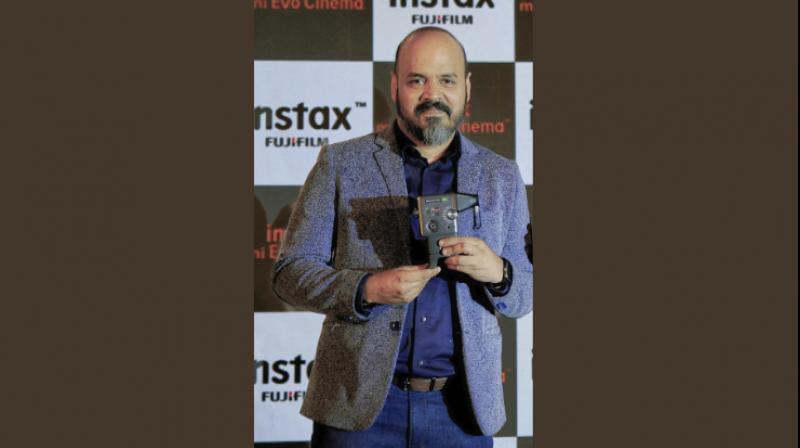
 Arun Babu
Instant photography has always lived at the intersection of memory and emotion. A click, a whirr, a slow reveal, and suddenly a moment becomes physical.
But the way one captures memories has changed. One shoots in motion now and tells stories through clips, Reels. boomerangs, and edits. Common perception is that the still image, on its own, is no longer enough.
With the launch of the instax mini Evo Cinema, Fujifilm India is responding directly to that cultural consumer shift. Fujifilm aims to rethink what instant photography can be in a video-first world. One where print doesn’t compete with screens, but connects with them.
The camera will be available in India from 28 January. The camera will be sold as a 'premium edition' combo, bundled with instax mini film packs.
The core idea behind the mini Evo Cinema is: what if a video could be handed over like a photograph? Users can capture short video clips, convert a frame into an instax print, and embed the moving memory within it through a QR code. The print stands on its own as an object, but scan it and the moment comes alive again.
It also has a companion app on mobile that extends this thinking further, allowing users to edit clips, stitch moments together, and even design poster-style prints.
Layered onto this is Fujifilm’s fascination with time itself. The new Eras Dial goes beyond filters, drawing inspiration from distinct visual cultures, from 1960s 8mm film to the imperfect glow of 1970s CRT screens. Each setting is tuned to evoke a mood, encouraging users to slow down, experiment, and shoot with intention rather than default perfection. The campaign tagline, ‘One camera, decades of possibilities,’ neatly sums up that ambition.
Even the design reinforces this philosophy. Borrowing cues from the FUJICA Single-8, the vertical grip, tactile dials, and print lever reintroduce a sense of physical interaction. This is a camera meant to be handled, not just tapped.
At the launch, we caught up with Arun Babu, associate director and head - electronic imaging, instax and optical devices business, Fujifilm India, to understand the thinking behind the mini Evo Cinema, the role of creators and storytellers in its rollout, and how Fujifilm sees the future of instant photography unfolding in India.
Edited excerpts:
What was the intent behind launching this product? What insight drove it, and how does it fit into the launches you’re doing overall? Also, how frequently do you typically launch products?
Every year, we launch a minimum of four to five products. There’s no fixed upper limit. Last year, for instance, we launched a product in February, then another one about two months ago in a completely different category. This is our first launch of 2026, and there are many more planned in the coming financial year. We already have a strong pipeline lined up for this year.
We strongly believe that today’s Gen Z and millennials live around images, content, and video. Instax, as a category, has traditionally been about instant cameras and instant images. This is our first short-form content or video creation product, and that’s where the idea came from.
With this product, one can create short video content of up to 15 seconds, convert it into a still image, and then print it. Through a QR code, you can scan that image and relive the video. That’s the core idea behind this launch.
Are there any campaigns planned around the launch?
This is primarily a product launch. It’s largely creator-led. One will start seeing a lot of influencers who have already tested the product sharing their content on social media. Influencer marketing will be a key focus.
We’ll also be doing multiple short-format launches across the country in different regions. Over the next few months, this will eventually scale into a larger campaign.
What role does filmmaker Imtiaz Ali play in this launch, and why partner with him?
Imtiaz Ali is one of the finest storytellers in the country. He’s created some truly iconic films and love stories that have become cult classics. He’s also been a long-time user of Fujifilm cameras.
When we showed him the new product, it made him nostalgic. He connected with the idea of capturing different eras and moments. That emotional connection is why he agreed to collaborate. As a filmmaker and cinematographer, he enjoys experimenting with gadgets that combine nostalgia with new-age technology. That’s where this partnership naturally came together.
Which touchpoints are working best for you right now?
From a sales perspective, we’re present across a wide range of touchpoints. We’re available in gadget stores, electronic stores, mobile stores, stationery shops, and large-format retail chains like Croma, Reliance, and Vijay Sales. We’re also present in regional chain stores.
On the digital side, we have our D2C website, instax.in. We’re active on e-commerce platforms like Amazon and Flipkart, and on quick commerce platforms such as Blinkit and Swiggy Instamart. Overall, the product is widely available across the country.
Online and offline sales are fairly balanced. It’s roughly a 50:50 split at the moment, and both channels are growing steadily.
From a marketing standpoint, what are you focusing on right now?
We run a mix of marketing initiatives. Influencers play a big role. We also work with brand ambassadors like actors Kriti Sanon and Kartik Aaryan, and we onboard several regional ambassadors during festive periods. It’s a very 360-degree marketing approach.
When you launch a new product, what metrics tell you that it’s working or scaling?
For every product, we clearly define the target persona first. Based on that, we built the marketing strategy. Social media is one of the biggest indicators today and a key metric for us. Alongside that, we also rely on traditional marketing, especially during festivals.
Looking ahead, how do you see this launch for instax mini Evo Cinema shaping up?
This is one of the most unique launches for us. Partnering with one of the senior-most directors in the industry adds immense credibility. He genuinely loves the product and has also committed to judging the content that will be created over the next three months.
We expect a strong influx of user-generated content, which will help us understand how the product is being perceived and received across audiences.
Lastly, is there any perception about Fujifilm that you’d like to debunk?
Fujifilm operates across multiple categories. Beyond imaging, we’re deeply involved in medical systems, office automation, materials, and even semiconductors at a factory level. In some countries, we’re also present in cosmetics.
Traditionally, people associate Fujifilm with cameras, instant cameras, lenses, and imaging. That’s our heritage business. I handle the imaging division, which includes Instax, cinema, and broadcast. But overall, Fujifilm is a truly multidimensional multinational company.